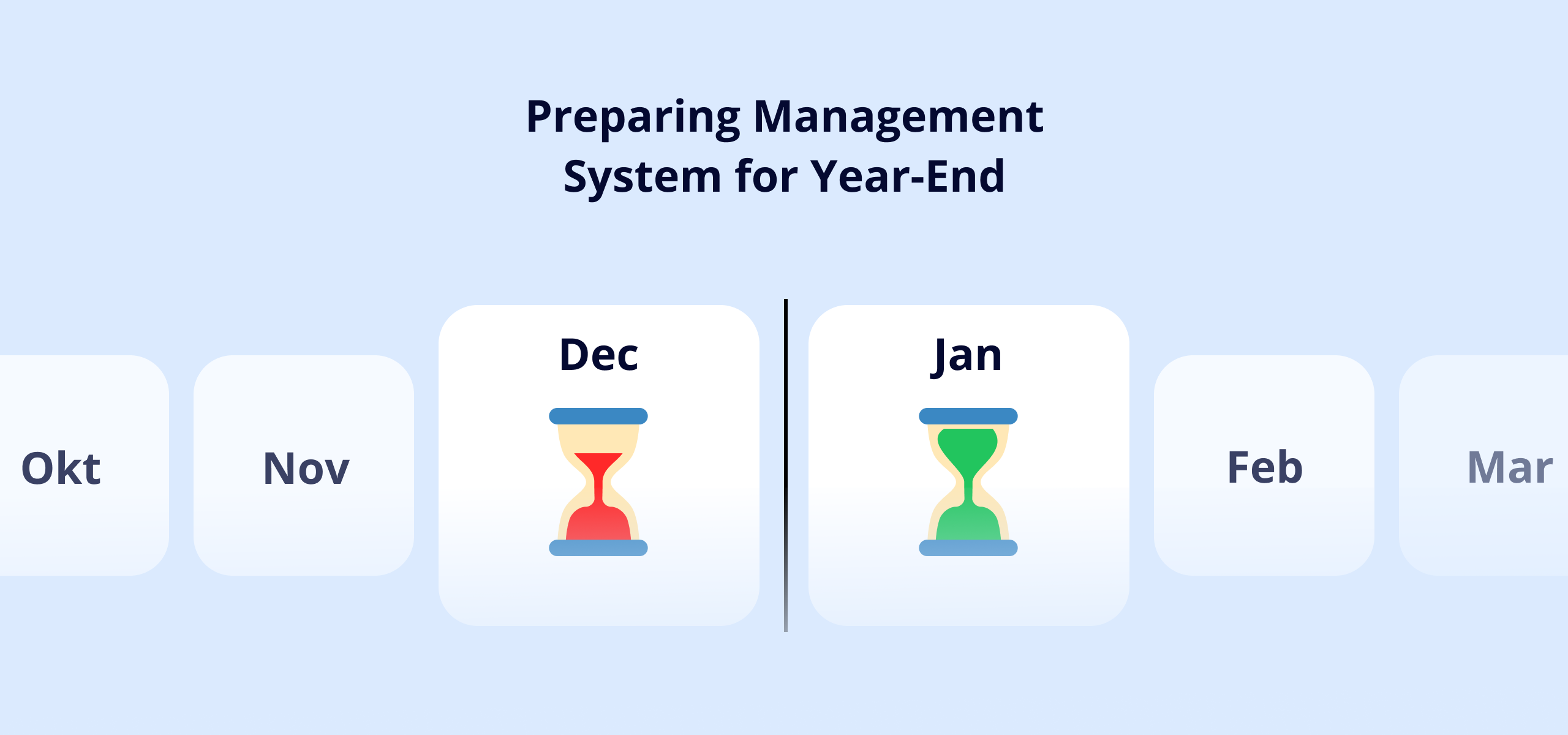
You probably already feel the stress of preparing your management system for year-end. December is here, and you know that January will be chaos if you don't do something NOW. Open non-conformities from Q1 that were never closed, training that was forgotten, and the management review that needs preparation – all at once in January while everyone else starts the year with fresh energy.
It doesn't have to be this way.
Do the right things NOW in December and you'll have a calmer January. Not a complete ISO checklist (that's overwhelming), but the five things that give the greatest impact with the least work. 10-15 hours total in December saves you 40-60 hours in January – and gives you a peaceful holiday without worrying "what did I forget?".
The five highest priority activities
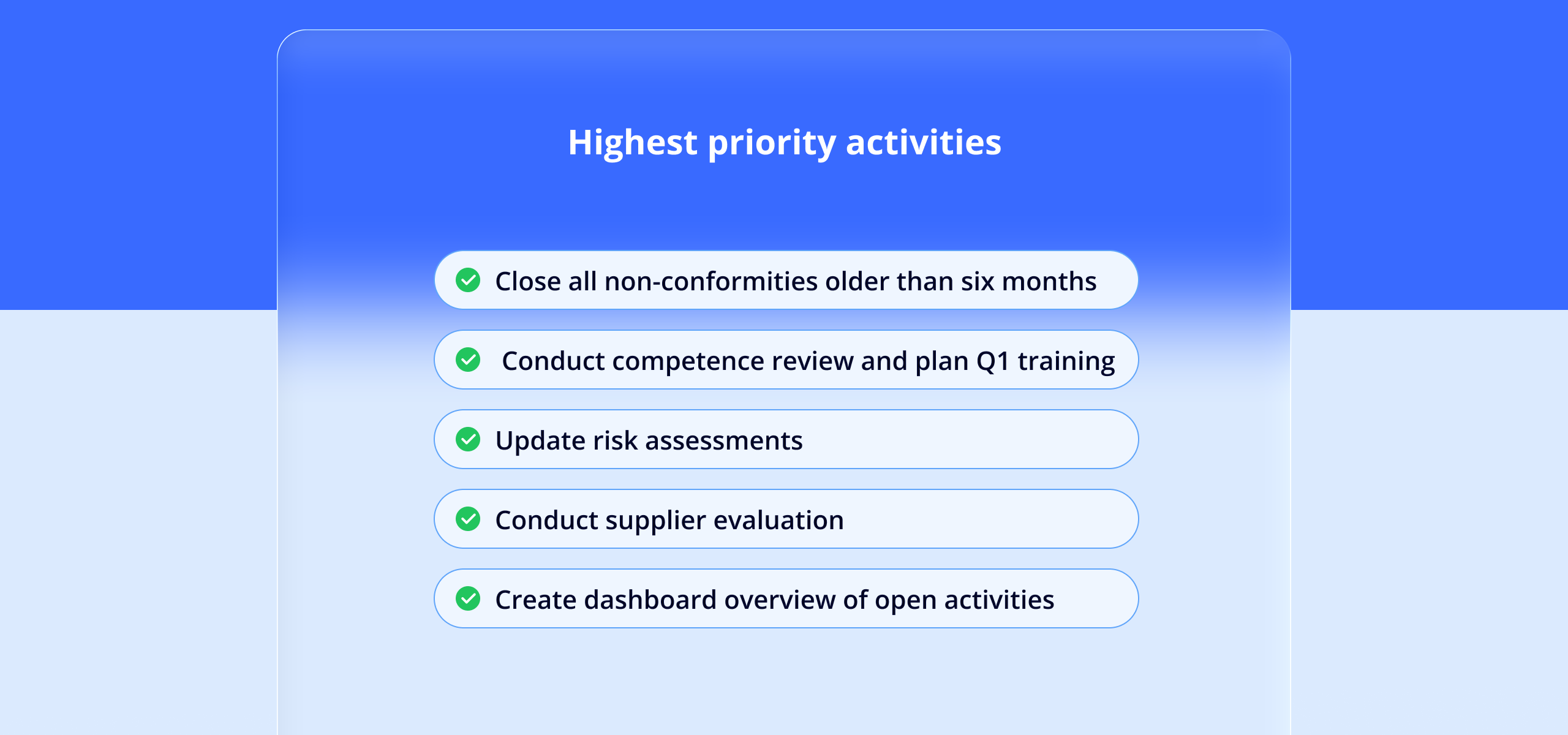
1. Close all non-conformities older than six months
Why (for YOU): Open non-conformities from spring that you've already forgotten about – but management hasn't forgotten. In January they ask "how many open non-conformities do we have?", and when you answer "47 of which 23 from Q1" the follow-up questions begin. Then you sit there explaining why a non-conformity from March is still open, when you don't actually remember what it was about.
How long: 3-5 hours depending on number of non-conformities. Most old non-conformities can be closed directly – the corrective action was probably done long ago, someone just forgot to close the case in the system.
ROI: 3-5 hours NOW → 15-20 hours saved in January. Each open non-conformity takes 15-30 minutes to figure out afterward ("who was responsible?", "what happened?", "did we close it or not?"). 23 old non-conformities = at least 6 hours of detective work in January.
How (in AmpliFlow):
- Go to Dashboard → click Improvements
- Filter Status: Open
- Sort by Age (oldest first)
- For each non-conformity older than 6 months:
- Check if corrective action was actually done (check history, ask responsible person)
- If action completed: Close the non-conformity directly with comment "Corrective action completed [date], closing before year-end"
- If action not completed: Two options:
- Do the action NOW (if quick fix)
- Or close the non-conformity and open new one with realistic deadline ("this will never happen" → acknowledge it and move on)
Concrete example: Non-conformity from March: "Supplier X delivered late". Corrective action: "Talk to supplier". You probably looked at this in April, talked to the supplier, and forgot to close the case. Close it NOW. If you did NOT talk to them – will you do it in December or acknowledge that it won't happen? Close anyway, possibly open new non-conformity if the problem persists.
2. Conduct competence review and plan Q1 training
Why (for YOU): When preparing year-end for the management system you don't need to do EVERYTHING – focus on the things that give the greatest impact. In January come performance reviews, salary revisions and operational planning – simultaneously. Then you won't have time to ALSO sit down and figure out "who needs which training?". If you do the competence review NOW you have ready training plans when January comes, and can just schedule them.
How long: 4-6 hours. 2 hours for competence review, 2-3 hours for training planning, 1 hour for booking.
ROI: 4-6 hours NOW → 20-25 hours saved in January. Without preparation it becomes emergency responses: "Oh, Kalle needs forklift certification and it expires in 3 weeks!" → panic → expensive emergency bookings → extra work finding a substitute.
How (in AmpliFlow):
- Go to Dashboard → Competence Matrix
- Filter: Show all employees
- For each employee: Check training expiring Q1 2026 (January-March)
- Create training plan:
- Critical training (forklift certification, hot work, occupational health): Book NOW for January
- Non-critical training (ISO awareness, quality tools): Schedule for February-March
- Go to Training Plan → Add all planned training with responsible person and deadline
- Email affected managers NOW: "Here's the training plan for your employees Q1 – add to your calendars"
Concrete example: You check the competence matrix and see that 5 employees have forklift certifications expiring in February. You book training NOW for week 4. In January when their manager asks "when should we do forklift training?" you answer "already booked, week 4". Instead of panic → calm control.
3. Update risk assessments if you've had major changes
Why (for YOU): If you launched a new product, changed supplier, or got new machinery during the year – and you did NOT update the risk assessment – it will come up in the management review. Then you sit there saying "no, we haven't risk-assessed the new machinery yet". Management won't be pleased. Do it NOW so you can say "yes, risk-assessed in December, no new serious risks".
NOTE: If you have NOT had major changes – skip this. Risk assessment for risk assessment's sake is a waste of time. But if you actually have changed – do it NOW before the management review.
How long: 2-3 hours if you've had changes. 0 hours if you haven't changed (then do it during regular risk review later).
ROI: 2-3 hours NOW → 10-15 hours saved in January. If management asks "have you risk-assessed X?" and the answer is "no", they'll say "do it for next meeting" → you get 1 week → emergency work → lost quality.
How (in AmpliFlow):
- Go to Dashboard → Risk Management
- Identify new activities/products/machinery/suppliers since last risk review
- For each change: Create new risk assessment or update existing
- Quality risks (ISO 9001): Affects product quality or customer satisfaction?
- Environmental risks (ISO 14001): New environmental aspects (chemicals, energy, waste)?
- Occupational health risks (ISO 45001): New work tasks or machinery?
- Document decision: "Risk-assessed 2025-12-XX, probability [low/medium/high], consequence [low/medium/high], action [description]"
- Done. Now you can say "yes, risk-assessed" in the management review.
Concrete example: You switched from Supplier A to Supplier B in September. You open risk management in AmpliFlow, create new supplier risk assessment for Supplier B (finances? quality? delivery time?), document probability/consequence, and add possible action ("request quality certificate before first delivery"). Done in 30 minutes. In January when management asks "is the new supplier risk-assessed?" you answer "yes, done in December".
4. Conduct supplier evaluation for your three most important suppliers
Why (for YOU): Supplier evaluation is one of those things that "always gets postponed". In January you need to prepare the management review, and then comes the question "how have suppliers performed?". If you don't have data the answer is "don't know" → management gets frustrated → you get assigned to "produce supplier statistics" → extra work in January.
Do it NOW for your 3-5 most important suppliers (those accounting for 80% of purchases or critical to operations). Skip the 47 other small suppliers – that's a waste of time.
How long: 2-3 hours for 3-5 suppliers. 30-40 minutes per supplier.
ROI: 2-3 hours NOW → 8-10 hours saved in January. Without preparation you have to start digging through invoices, email conversations, non-conformity cases in January – "how many times did they deliver late?" → takes 2 hours per supplier just to gather data.
How (in AmpliFlow):
- Identify your 3-5 most important suppliers (highest purchase value or critical to operations)
- Go to Dashboard → Supplier Management
- For each supplier: Document
- Delivery precision: Did they deliver on time? (check purchase orders, ask purchasing manager)
- Quality: Non-conformities or complaints during the year? (check non-conformity register)
- Communication: Did they respond quickly to questions? (ask purchasing manager)
- Rate: Approved / Approved with remarks / Not approved
- Add to AmpliFlow with date and comment
- Done. Now you have answers ready when management asks "how are the suppliers?".
Concrete example: Your most important raw material supplier. You check purchase orders from this year – 12 deliveries, 2 delayed (83% on time). You check the non-conformity register – 1 quality non-conformity in May (resolved immediately). You talk to purchasing manager – "they always respond within 24 hours". You document in AmpliFlow: "Approved with remarks (2 delays, but quality OK)". Done in 40 minutes. In January you have answers ready.
5. Create dashboard overview of open activities
Why (for YOU): The worst thing about January is the feeling of "what did I forget?". You know you should do something, but you don't know WHAT. Create a simple dashboard overview NOW so you know exactly what needs to be done in January – and you can prioritize.
How long: 1-2 hours. Once per quarter (do it NOW before year-end, then again before Q2/Q3/Q4).
ROI: 1-2 hours NOW → 10-15 hours saved in January. Without overview you waste time on "what should I do today?" → inefficient planning → forget things → emergency responses.
How (in AmpliFlow):
- Go to Dashboard (home page)
- Filter: Show all open tasks
- Categorize by priority:
- Urgent (do before holiday): Things blocking Q1 start (e.g. non-conformities to be closed, documents expiring Dec 31)
- High (first week January): Management review preparations, Q1 follow-up
- Normal (January-February): Training, internal audits, document review
- Create a recurring checklist for year-end (so you don't need to think about this every year)
- Print or email yourself: "My January TODO based on current status"
Concrete example: You open Dashboard in AmpliFlow and see:
- 12 open non-conformities (3 urgent, 9 can wait until January)
- 5 documents expiring December 31 (must review NOW)
- 2 internal audits planned for January (schedule NOW)
- 8 training sessions planned Q1 (already scheduled, nothing to do)
You categorize: "Urgent: 3 non-conformities + 5 documents = do before Dec 20". "January week 1: Book auditors". Done. Now you know exactly what to do – no panic.
Summary: What you get back
Preparing year-end for the management system doesn't need to take weeks – focus on these five activities.
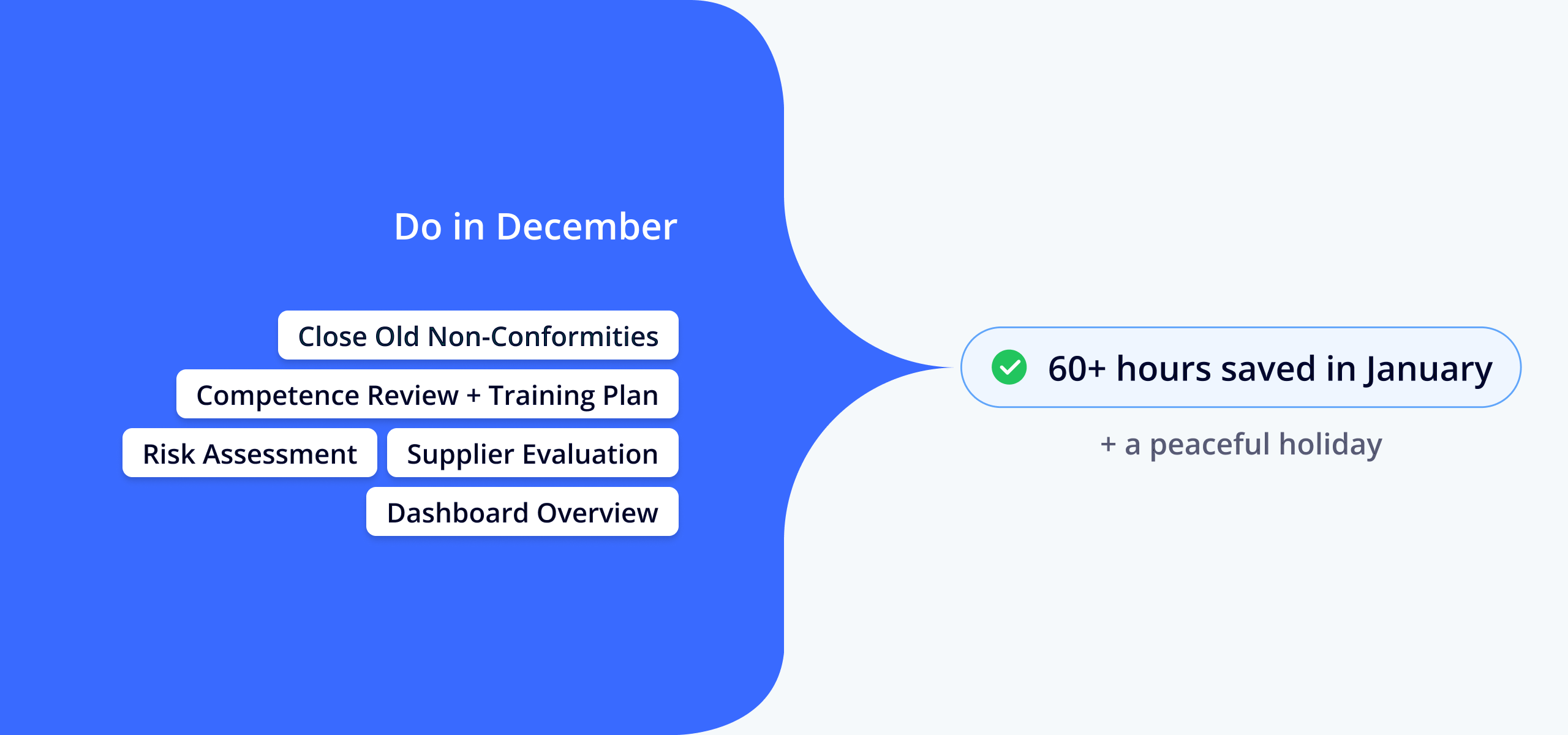
If you do these five things NOW in December:
- Close old non-conformities: 3-5 hours
- Competence review + training plan: 4-6 hours
- Risk assessment (if changes): 2-3 hours
- Supplier evaluation (3-5 suppliers): 2-3 hours
- Dashboard overview: 1-2 hours
Total: 12-19 hours in December.
What you save in January:
- No panic-closing old non-conformities: 15-20 hours saved
- No emergency training booking: 20-25 hours saved
- No emergency risk assessment: 10-15 hours saved
- No emergency supplier data: 8-10 hours saved
- No "what did I forget?" stress: 10-15 hours saved
Total: 63-85 hours saved in January.
But the most important thing isn't the hours. The most important thing is that you can have a peaceful holiday without worrying "what did I forget?". You know you've done what you can, and that January is prepared.
Do this NOW. Start with activity 1 (closing old non-conformities) – it gives the greatest impact and is concrete. Then take the next one. You have time.
About the time estimates
The times above are based on experience from small-to-medium enterprises (20-200 employees) with established management systems. Your actual time may vary depending on company size, number of open cases, and how well you use your management system today.
Regardless of exact hours, the principle is the same: preparing NOW always saves more time than firefighting in January.
Common questions
Why only five activities? ISO requires more, doesn't it?
Yes, the ISO standards have long requirement lists. But if you try to do EVERYTHING you get overwhelmed and do nothing. These five activities are the ones that:
- Give greatest impact (visible to management, time-consuming if postponed)
- Are realistically possible to do in December (12-19 hours total)
- Reduce your personal stress most (fewer emergency responses in January)
The rest of the ISO requirements you can handle continuously during the year – or address at the regular management review. This is "smart preparation", not "complete compliance checklist".
What happens if I do NOT do this?
You get a stressful January. Specifically:
- Management asks "how many open non-conformities?" → you answer "don't know, must check" → lose credibility
- Employee says "my forklift certification expires next week" → you panic-book expensive emergency training
- Manager asks "is the new supplier risk-assessed?" → you answer "no, not yet" → you get it as urgent task
- You work overtime in January instead of starting the year with energy
Do this NOW and you get controlled start in January instead of emergency responses.
Must I use AmpliFlow for this?
No. The principles work in any management system (or even in Excel if you run manually). But AmpliFlow makes it easier because you have dashboard overview, reminders, and linked activities in one place. If you use another system – adapt the workflows accordingly.
What do I do about the management review?
The management review (ISO 9001 Clause 9.3, ISO 14001 Clause 9.3, ISO 45001 Clause 9.3) is important – but it should be done in January/February, not in December. If you do these five activities NOW you have all data ready when it's time for the management review:
- Non-conformity report: Done (no old open cases)
- Competence report: Done (training plan for Q1 ready)
- Risk report: Done (updated risk assessments)
- Supplier report: Done (evaluation of most important suppliers)
The management review becomes a 2-hour effective review instead of a 6-hour chaotic "we have no data" session.
How do I make this a routine every year?
Create a recurring checklist in AmpliFlow:
- Schedule: "Year-end preparation" with deadline December 30
- Add the five activities as items
- Assign responsible (yourself or quality team)
- Set frequency: Annually, December
Next year in October you get automatic reminder in AmpliFlow: "Year-end preparation starts in 4 weeks". Then you don't need to remember – the system reminds you.


