For management system owners, ISO clause 10 "Improvement" is the core of value creation – this is where reactive deviation management becomes proactive improvement. This guide shows you how to implement ISO 10 corrective actions according to ISO 9001:2015 clause 10.2 and drive continual improvement according to clause 10.3. However, this is applicable to all ISO management system standards that include clause 10, such as ISO 14001 (environmental), ISO 45001 (occupational health and safety), and ISO 27001 (information security).
Why ISO Clause 10 Is Critical
Many organizations document deviations but lack a systematic approach to corrective actions. You write down the problem, address the symptom, and move on – until the same deviation appears again. ISO clause 10 requires you to dig deeper: find the root cause, address it permanently, and prevent recurrence. Structured deviation management creates value by transforming problems into improvement opportunities.
ISO 9001:2015 structures improvement work into two parts:
- Clause 10.2: "Nonconformity and corrective action" – manage deviations systematically with ISO 9001 deviation management
- Clause 10.3: "Continual improvement" – improve continuously even without deviations
This article provides you with concrete tools for both areas.
Definitions: Deviation, Nonconformity, and Improvement Opportunity
Before you start: understand the difference between the concepts.
Deviation = When something doesn't go according to plan. Example: a delivery arrives two days late.
Nonconformity (non-fulfillment of a requirement) = When you don't meet a requirement (from customer, standard, or law). Example: the product lacks CE marking required by law.
Improvement opportunity = You meet the requirements but see how you can do better. Example: customer satisfaction is 4/5, you want to reach 4.5/5.
ISO clause 10.2 focuses on deviations and nonconformities (Swedish companies commonly group both under the term "deviation") – when requirements are not met or something goes wrong. Clause 10.3 focuses on improvement opportunities – raising the bar even when everything works. AmpliFlow supports deviation management in your processes through structured documentation and follow-up.
ISO 10.2: Corrective Actions for Nonconformity
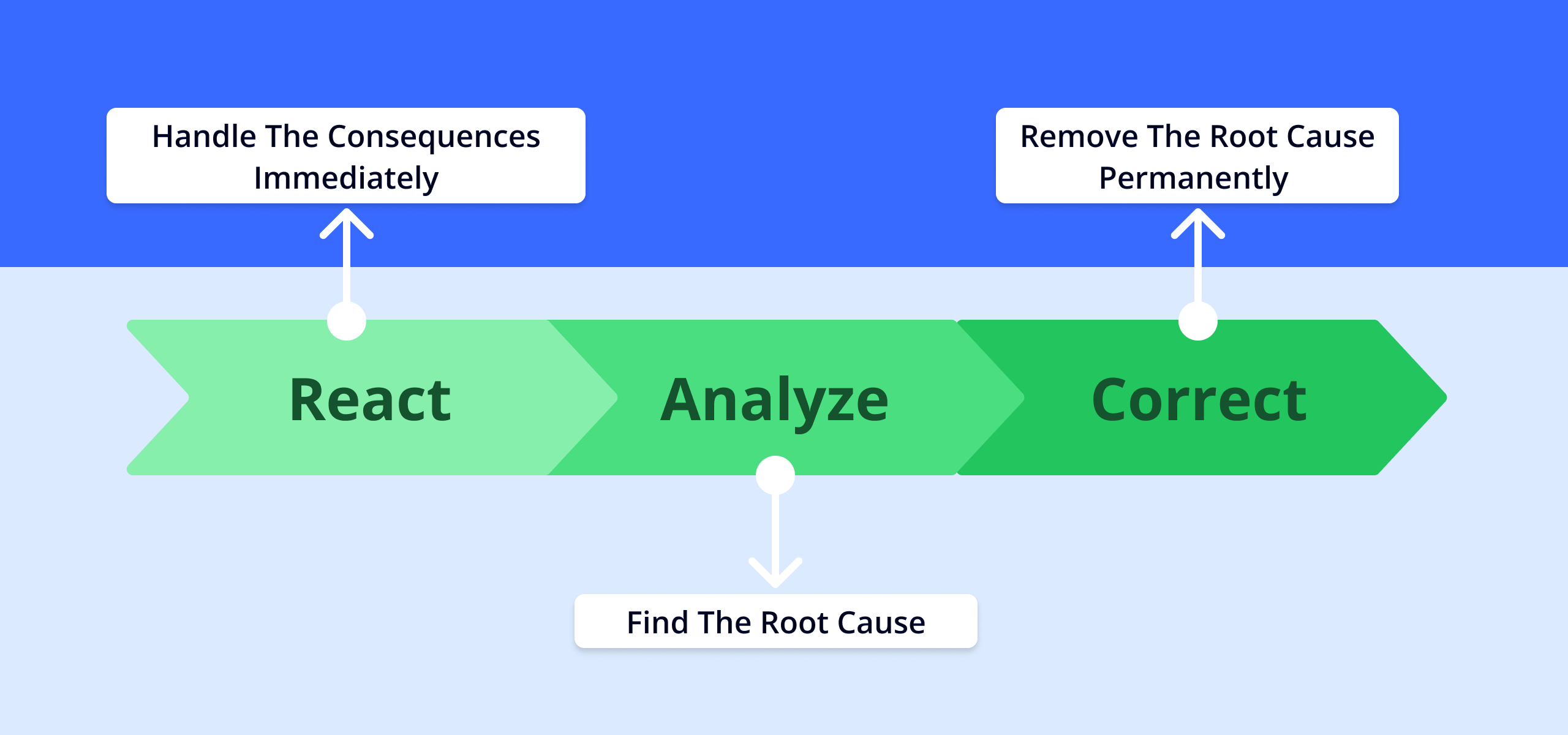
When you find a deviation, you must do three things according to ISO 10.2 to implement ISO 10 corrective actions:
- React – Handle the consequences immediately (containment)
- Analyze – Find the root cause (root cause analysis)
- Correct – Remove the root cause permanently and prevent recurrence
Step 1: React and Limit the Damage
When the nonconformity is discovered, act immediately to limit the damage.
Containment actions = Immediate actions to stop the problem from spreading.
Examples:
- Product defect: Stop delivery, quarantine products
- Process error: Pause the process, inform affected customers
- System failure: Revert to manual process until the system is repaired
Document what you did and when. This is not root cause analysis – this is first aid.
Step 2: Analyze and Find the Root Cause
Now the systematic work begins. You must answer: Why did this happen?
ISO requires you to evaluate the need for corrective action by determining the causes of the nonconformity. There are several methods for root cause analysis – the most common are 5 Whys, Fishbone diagram, and 8D methodology.
5 Whys – Simple and Powerful Root Cause Analysis
Ask "why" five times to get from symptom to root cause.
Example from Toyota (Taiichi Ohno):
Problem: The machine stopped.
- Why did the machine stop?Overload blew the fuse.
- Why was there an overload?The bearing was not sufficiently lubricated.
- Why wasn't it lubricated?The lubrication pump wasn't pumping sufficiently.
- Why wasn't it pumping?The pump shaft was worn and rattling.
- Why was the shaft worn?No strainer was installed, metal scraps got in.
Root cause: No strainer installed → Corrective action: Install strainer on all lubrication pumps.
Without 5 Whys, you would have replaced the fuse and called it solved. The problem would have recurred.
When you use 5 Whys:
- Base each "why" on the previous answer
- Don't stop at five if the root cause isn't clear
- Verify the root cause with data (don't guess)
Fishbone Diagram (Ishikawa Diagram) – Map All Possible Causes
When the problem is complex and may have multiple causes, use a Fishbone diagram. The method was created by Kaoru Ishikawa in the 1960s and is one of the seven basic tools of quality control.
Structure:
- Fish head = The problem (the nonconformity)
- Spine = Main categories of causes
- Bones = Specific causes within each category
The 5 Ms (most common in manufacturing):
- Man/Manpower (personnel): Competence, training, experience
- Machine (equipment): Equipment, technology, maintenance
- Material (materials): Raw materials, consumables, quality
- Method (process): Process, instructions, procedures
- Measurement (inspection): Inspection, control, environment
Example: Delayed Deliveries
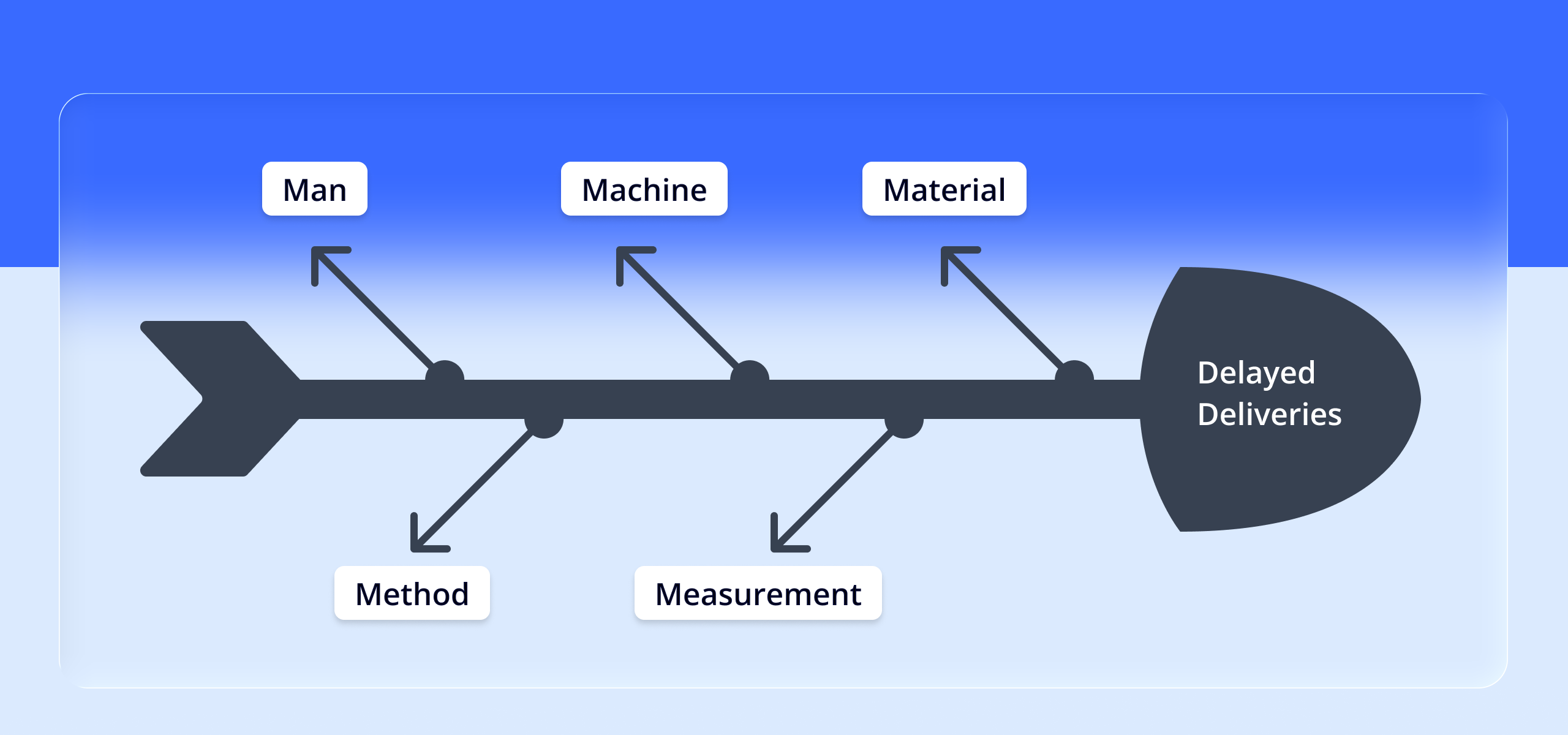
Man: New staff lack trainingMachine: Inventory system slow, old serversMaterial: Suppliers deliver lateMethod: No prioritization of urgent ordersMeasurement: No real-time monitoring of inventory levels
How to use Fishbone:
- Define the problem clearly (fish head)
- Choose the right categories (5 Ms for manufacturing, 5 Ss for service)
- Brainstorm causes in each category (teamwork gives best results)
- Dig deeper with 5 Whys for each cause
- Verify which causes actually contribute to the problem
8D Methodology – Structured Problem Solving from Ford
8D (Eight Disciplines) is a comprehensive method developed by Ford Motor Company in 1987. It combines root cause analysis with teamwork and preventive actions.
The eight disciplines:
D0: Preparation and Emergency Response ActionsPlan the problem-solving. Document symptoms and emergency response actions.
D1: Use a TeamAssemble a team with product and process knowledge. Different perspectives give better solutions.
D2: Describe the ProblemSpecify the problem in measurable terms: who, what, where, when, why, how, how many (5W2H).
D3: Develop Interim Containment PlanStop the problem from reaching the customer. Quarantine products, inform affected parties.
D4: Determine and Verify Root CausesIdentify all possible causes. Use 5 Whys or Fishbone diagram. Verify causes with data.
D5: Verify Permanent CorrectionsConfirm that the chosen action actually solves the problem. Test before full implementation.
D6: Implement Corrective ActionsImplement the permanent action. Validate with empirical evidence of improvement.
D7: Prevent RecurrenceUpdate management systems, processes, and procedures to prevent the same problem from occurring again.
D8: Congratulate the TeamFormally recognize the team's contribution.
When to use 8D:
- Problems that recur despite actions
- Complex problems with many possible causes
- When the customer requires detailed root cause analysis
- ISO certification audit requires documented problem-solving process
8D gives you documentation that meets ISO 10.2 requirements: you show that you reacted (D0-D3), analyzed the root cause (D4), implemented corrective action (D5-D6), and prevented recurrence (D7).
Step 3: Implement and Verify Corrective Action
Once the root cause is established, remove it permanently. This is the core of ISO 10 corrective actions.
Corrective action = Action that eliminates the cause of a detected nonconformity or other undesirable situation.
Important: Corrective action should be proportional to the effects of the nonconformity. A minor problem doesn't require as extensive analysis as a critical customer problem.
Verification: Check that the action works. Collect data over time to confirm that the nonconformity doesn't recur.
Documentation: ISO requires you to retain documented information about:
- Nature of the nonconformity
- Actions taken
- Results of corrective action
Escape Point Analysis – Why Did You Miss the Problem?
The 8D methodology introduces an important concept: escape point.
Escape point = The earliest control point in the process that should have detected the problem but failed.
Example: A product with incorrect dimensions reaches the customer.
- Root cause: Machine miscalibrated
- Escape point: Final inspection didn't detect the error
You must address BOTH the root cause (calibrate the machine) AND the escape point (improve final inspection so the error is detected next time).
This prevents similar problems from slipping through in the future.
ISO 10.3: Continual Improvement
Clause 10.3 takes you beyond reactive problem-solving. Even when no nonconformities exist, you should continuously improve the management system's suitability, adequacy, and effectiveness. ISO certification is the foundation for continual improvement that creates long-term value.
Continual improvement = Recurring activity to increase the ability to fulfill requirements.
ISO 10.3 requires you to identify and select improvement opportunities that support customer requirements and improve customer satisfaction.
The PDCA Cycle – The Engine for Continual Improvement
Plan-Do-Check-Act (PDCA) is the foundation of ISO's process approach. The method was developed by Walter Shewhart and further developed by W. Edwards Deming.

Plan
Identify problem or improvement opportunity. Set goals and develop hypothesis or strategy.
Concrete:
- Analyze current performance
- Identify root causes (if problems exist)
- Set SMART goals (Specific, Measurable, Accepted, Realistic, Time-bound)
- Involve relevant stakeholders
Example: Customer satisfaction is 4.0/5, the goal is 4.5/5 within six months. Analysis shows that customer support response time is too long.
Do
Implement the plan on a small scale to minimize risk.
Concrete:
- Ensure everyone understands their roles
- Follow standardized procedures
- Document what you do
Example: Test new support procedure with one support team for four weeks. Measure response time daily.
Check
Analyze results and evaluate what worked or didn't.
Concrete:
- Collect feedback
- Compare results against goals
- Identify deviations
- Determine if the test succeeded
Example: Response time decreased from 4 hours to 2 hours. Customer satisfaction increased to 4.3/5. The team reports that the new procedure is manageable.
Act
Standardize successful changes or revise the plan and test again.
Concrete:
- If successful: Implement across the organization, update procedures, train staff
- If unsuccessful: Analyze why, adjust the plan, run new PDCA cycle
Example: Roll out the new support procedure to all support teams. Update work instructions. Continue measuring customer satisfaction to ensure sustainability.
Where PDCA Can Be Used
PDCA is extremely flexible and supports ISO 10 corrective actions across all industries:
Manufacturing: Reduce waste, streamline production lines, improve quality controls
A manufacturing company discovers that 3% of products have paint defects. Plan: Analyze root cause with Fishbone diagram – finds that spray booth temperature varies. Do: Test new temperature control in one spray booth for two weeks. Check: Paint defects decrease to 0.5% in test booth. Act: Install temperature control in all spray booths, update maintenance procedures.
Service: Improve response times, customer experience, delivery quality
A consulting firm receives complaints about late project deliveries. Plan: Identify root cause – project managers lack resource planning tools. Do: Test project management tool with two project managers for three months. Check: Both projects delivered on time, project managers report better overview. Act: Roll out the tool to all project managers, train in resource planning.
Healthcare: Improve patient flows, reduce errors, increase patient safety
A health center has long waiting times. Plan: Map patient flow, find bottleneck at registration. Do: Test digital check-in for walk-in patients for one month. Check: Waiting time decreases from 45 to 25 minutes, patient satisfaction increases. Act: Implement digital check-in permanently, update patient information.
Software Development: Iterate features, improve deployment, reduce bugs
A development team has many bugs in production. Plan: Analyze root cause – insufficient testing before release. Do: Test automated tests for critical functions during two sprints. Check: Bugs in production decrease by 60%, team identifies errors earlier. Act: Expand automated tests to all functions, integrate into CI/CD pipeline.
If you launch a new process or refine an existing one, PDCA gives you data-driven decision support.
Common PDCA Pitfalls
Skipping the Check phase: You implement unproven changes across the entire organization. Result: wasted resources when the change doesn't work.
Over-planning: You get stuck in the analysis phase. Planning takes months, nothing happens.
Lack of ownership: Without team engagement, improvement work dies out.
No follow-up: Improvement stops if Act doesn't lead to standardization.
Solution: Treat PDCA as a continuous loop, not a one-time project.
Combine Root Cause Analysis and PDCA
For best results: combine the tools.
For nonconformity (ISO 10.2):
- Plan: Use 5 Whys or Fishbone to find root cause
- Do: Implement corrective action on a small scale
- Check: Verify that the nonconformity doesn't recur
- Act: Standardize the action, update procedures
For improvement opportunity (ISO 10.3):
- Plan: Identify what can be improved, set goals
- Do: Test the improvement
- Check: Measure results against goals
- Act: Roll out or adjust the plan
Practical Implementation in Your Management System
Here's how to make ISO clause 10 a natural part of daily work. A structured management system supports systematic improvement work.
1. Create Clear Processes
Document how deviations and improvement opportunities are handled:
- Who reports deviations?
- Who is responsible for root cause analysis?
- Which method do you use (5 Whys, Fishbone, 8D)?
- How are corrective actions documented?
- How do you follow up that actions work?
2. Use the Right Tool for the Right Problem
Simple problems: 5 Whys is often sufficient. Fast, requires no statistical analysis.
Complex problems: Fishbone diagram provides overview when many factors are involved.
Recurring problems or customer requirements: 8D gives you complete documentation and systematics.
Improvement work: PDCA for all types of improvements, large and small.
3. Engage the Team
Root cause analysis works best as teamwork. Different perspectives reveal causes that one person misses.
Tips:
- Include people from different functions
- Use Fishbone in workshops (brainstorming gives best results)
- Document the discussion, not just the conclusion
4. Measure and Follow Up
Collect data to verify improvements:
- Cycle time and lead time: Is work getting faster?
- Error frequency: Are quality problems decreasing?
- Employee engagement: Does the team participate actively?
- Goal achievement: Are PDCA results implemented?
5. Standardize Successes
When a corrective action or improvement works: update your procedures, work instructions, and training materials. Otherwise, you risk old habits returning.
6. Link to Management Review
ISO 9001 clause 9.3 requires management to regularly review the management system. Use data from clause 10:
- Number of nonconformities and trends
- Effectiveness of corrective actions
- Results of improvement initiatives
- Follow-up of PDCA cycles
This shows auditors that your management system actually drives improvement.
Documentation Requirements According to ISO 10.2
ISO 10.2 requires you to retain documented information about:
- Nature of the nonconformity: What happened? When? Where? Which requirements were not met?
- Actions taken: Emergency actions (containment) and corrective actions
- Results of corrective action: Did the action work? Has the problem recurred?
Practical:
- Create a deviation report template with fields for root cause analysis (5 Whys or Fishbone)
- Document each step in the 8D process if you use that method
- Save verification data showing the action worked
- Link deviations to processes to see patterns
Document management ensures you meet ISO 10.2 documentation requirements and can track improvements over time.
Avoid Common Mistakes with ISO 10 Corrective Actions
Mistake 1: Treating symptoms instead of root cause analysis
You address the consequence, not the cause. The problem recurs.
Solution: Always use at least 5 Whys. Ask "why" until you reach the root cause.
Mistake 2: Disproportionate actions
You do extensive 8D analysis for every minor deviation. Waste of resources.
Solution: Adapt method to problem severity. Simple problems: 5 Whys. Complex/recurring: Fishbone or 8D.
Mistake 3: Forgetting the escape point
You fix the root cause but not why the problem wasn't detected earlier.
Solution: Always ask "why wasn't this detected earlier?" and improve your controls.
Mistake 4: No follow-up
You implement the action and move on. No one verifies it works long-term.
Solution: Set follow-up dates in the calendar. Check that the problem doesn't recur after 1, 3, 6 months.
Mistake 5: PDCA becomes a one-time project
You run one PDCA cycle, then stop.
Solution: PDCA is a loop. When you reach Act, start the next Plan phase with new goals.
Summary: From Reaction to Proactive Improvement
ISO clause 10 is your roadmap from firefighting to systematic improvement. ISO 10 corrective actions transform problems into improvement opportunities.
Clause 10.2 (Corrective actions):
- React and limit the damage
- Analyze the root cause (5 Whys, Fishbone, 8D)
- Implement permanent corrective action
- Verify that the problem doesn't recur
- Improve your controls (escape point analysis)
Clause 10.3 (Continual improvement):
- Identify improvement opportunities
- Use the PDCA cycle (Plan-Do-Check-Act)
- Test improvements on a small scale
- Standardize successes
- Continue the cycle (continuous improvement)
Choose the right tool:
- 5 Whys: Simple problems, quick analysis
- Fishbone: Complex problems, multiple possible causes
- 8D: Recurring problems, customer requirements, ISO documentation
- PDCA: All improvement initiatives
When you build these methods into your procedures, improvement work becomes a natural part of daily work – not an extra project on the side. That's when ISO certification delivers real value: you improve your ability to deliver to customers, reduce waste, and build a culture where problems are seen as opportunities.
Start small: choose a recurring deviation, run a 5 Whys analysis, implement the action, and follow up. When the method sticks, take the next step with Fishbone or PDCA. Over time, systematic improvement becomes your competitive advantage.


